
Reward Heads
Using our heads to solve your Reward challenges.

At Reward Heads, we have shared a number of articles about Pay Transparency over the last year because it has been, and remains, a hot topic.
Organisations are taking steps to review their reward practices and certainly in the UK there is a call for more organisations to share salary ranges on job adverts. The EU Pay Transparency Directive is driving much of the change with Mercer reporting that 57% of organisations are reassessing their pay structures to meet transparency demands. A recent survey from WTW suggests 76% of UK businesses plan to share pay ranges with employees and 70% with external candidates.
However, as we have said before, this is a marathon not a sprint and for many getting to the stage where they feel confident in being transparent in their pay structures and processes will take time. We have had many conversations with clients about taking logical steps to review their current approach and identify areas of focus as sometimes it can be difficult to see the wood for the trees.
According to Korn Ferry only 12% of global organisations have fully implemented a pay transparency strategy but 29% are actively reviewing it suggesting that we may see a bigger shift as EU countries start to legislate the Directive and organisations get to grips with the steps they need to take.
Given the EU Directive is not yet fully legislated (member states have until June 2026 to implement the provisions of the Directive) and the UK is not covered now, we thought we would look beyond Europe and share what is going on globally in pay transparency where there are already countries with rules in place. These may give insights into the future direction of legislation in the UK or what global employers might consider as their policies across the world.
Canada
Rules in Canada are set by Province and we are focussing in on the largest Province (by population at least) of Ontario.
Even small employers with just ten or more employees are required to create a pay equity plan based on the evaluation of jobs and gender assessments including the comparison of male and female job classes (where either men or women occupy at least 60% of the roles or have historically occupied them. Any role not fitting either category is gender neutral).
Any pay gap identified through this process should be corrected, and the Pay Equity Commission is responsible for monitoring compliance.
From 1 January 2026 employers will have additional responsibilities:
Fines are up to CAD 5,000 for first offence and up to CAD 100,000 for repeated infringements (between £2,700 and £54,000).
Outside of Ontario, there are gender pay gap reporting requirements for employers with more than 100 employees.
USA
Rules in the US are set by each State and several (e.g. California, New York and Washington) have enacted laws requiring salary ranges in job postings which in turn have pushed many organisations towards a more structured compensation framework.
However, this covers just 20% of workers and although there is no Federal mandate as yet, momentum is growing especially around gender pay equity.
Australia
The Fair Work Legislation Amendment Act 2022 banned pay secrecy clauses in employment contracts giving employees the legal right to share their pay and employment conditions with others. This is part of the government's “Secure Jobs, Better Pay” initiative, aimed at reducing the gender pay gap and promoting workplace equity.
Similar to the UK, many job ads still lack salary information with the main reason given being to maintain negotiation leverage or conceal non-competitive rates.
Australian organisations with more than 100 employees also have to report on gender pay gaps.
Iceland
Iceland are seen as a global leader in pay equity due to the introduction of equal pay certification. “Iceland is spearheading the fight against gender discrimination with new legislation on equal pay certification,” say experts from the UN Working Group on Business and Human Rights and the Working Group on the Issue of Discrimination against Women in Law and in Practice.
Organisations with 25+ employees are required to obtain equal pay certification and employers must prove that they pay men and women equally for the same work. The certification requires the following:
Comparison by Country
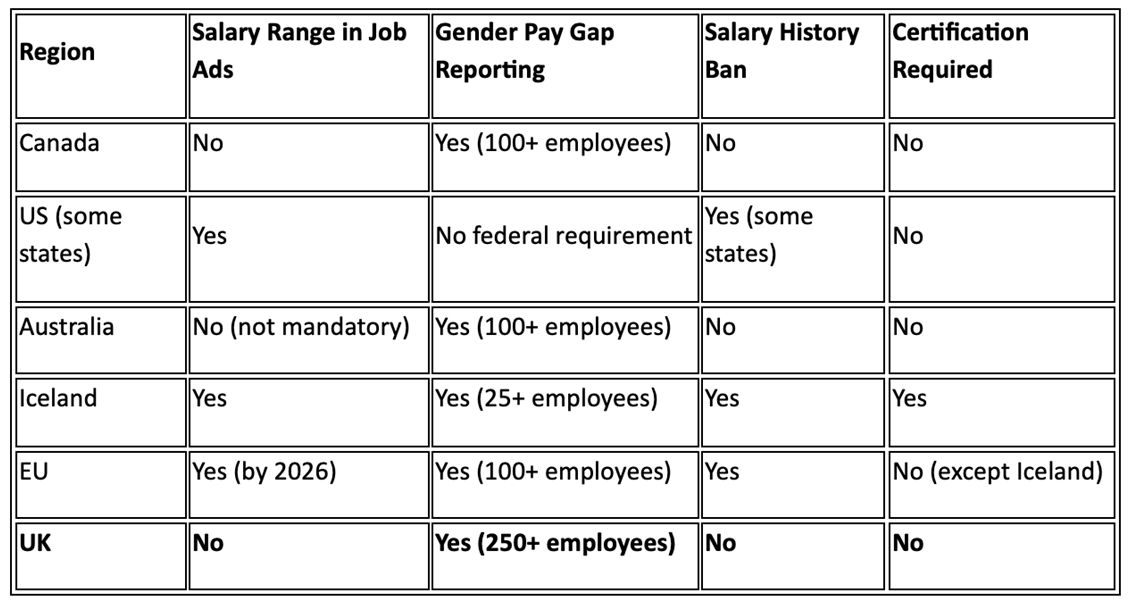
Comparison by Counrty for factors affecting Pay Transparency
So what does this mean for the UK?
Despite some of these positive actions, Aon's 2025 study found that only 19% of companies feel truly ready for full pay transparency. The summary table shows the different approaches being taken, but also highlights how far behind the UK are with no formal regulations around transparency and the least proportion of employers mandated to conduct gender pay gap reporting.
From our conversations, however, we do see that many UK organisations are keen to improve transparency in Reward. What once may have been an ideology is now driving leadership level conversations and reviews in reward practices being led by the recognition that pay transparency matters to the success of the organisation in attraction, retention and employer branding.
Some UK organisations are taking note of the EU Pay Transparency Directive to consider their next steps, so let's remind ourselves of the requirements:
The deadline for member states to implement the directive is June 2026. At time of writing, countries like Belgium, Ireland, the Netherlands, Poland, and Sweden have already started transposing the directive into national law. We will be keeping our eyes peeled for updates over the next 9 months.
If like many of the organisations we speak to, you are keen to do 'something' but are not quite sure where to start, perhaps taking part in our Pay Transparency Assessment will help make sense of what is a particularly broad subject. It is free and will take about 10-15 minutes. https://rewardheads.scoreapp.com
If you already know that you'd like to talk to us, please reach out on rewardsolutions@rewardheads.co.uk
Christina Jones - Consulting Manager