
Reward Heads
Using our heads to solve your Reward challenges.

Bonuses are supposed to be the carrot (or a stick) that makes the donkey move (apologies for the mental image of your high-performing colleagues as donkeys). In theory, incentives should focus everyone's energy on what matters most to the organisation. In practice? The carrot often ends up dangling in the wrong place.
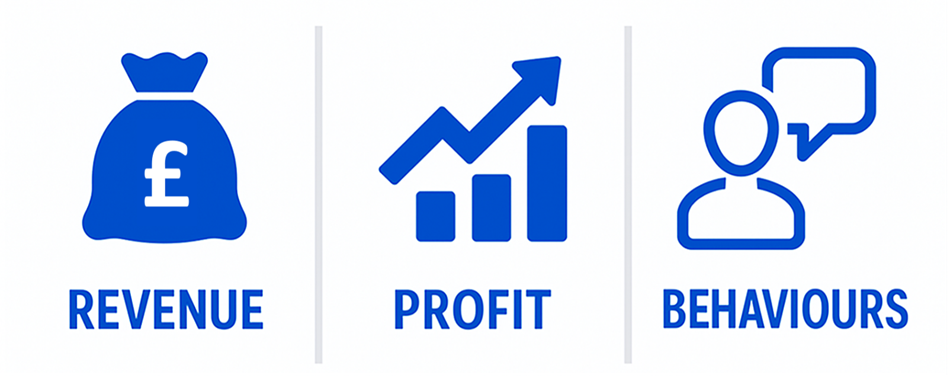
The big question is: what should bonuses actually reward? Revenue? Profit? Or those less tangible but equally important things like leadership and collaboration?
Revenue: the tempting measure
On the surface, revenue (aka sales, turnover) is wonderfully simple. Sell more, earn more. It's easy to measure, easy to explain, and easy to celebrate. A sales team hitting their target makes for a great Town Hall/Company Meeting announcement.
But there's a catch: revenue doesn't always equal success. A business can grow top-line sales while quietly losing money at the bottom line. I once worked for a company that handed out champagne because revenues had surged 20% — only to discover a few weeks later that costs had surged 25%. The corks popped, but so did the CFO's blood pressure.
Rewarding revenue alone can also encourage unhealthy behaviour: discounts that erode margins, overpromising to customers, or focusing only on short-term wins.
Profit: the grown-up choice
If revenue is the exciting headline, profit is the sober fine print. Rewarding profit feels more sustainable: after all, no business can survive without it. Bonuses tied to EBITDA or margin protect against the “champagne and nosebleed” scenario above.
However, profit isn't always in an employee's direct control. Market shifts, currency fluctuations, or a sudden spike in energy costs can obliterate margins overnight. Telling staff their bonus has vanished because of events across the world's political stage is not exactly morale-boosting.
Profit is essential, but it's often too distant from day-to-day behaviour to feel fair.
Behaviours: the underrated option
Then there's the “softer” side: rewarding behaviours, like collaboration, leadership, innovation, or living the company's values. This approach recognises that long-term success comes from how people work, not just what they deliver.
The challenge? Measuring behaviours can be difficult. How many “collaboration points” equal a bonus? If you've ever sat in a meeting trying to score someone's “team spirit” out of ten, you'll know how awkward it gets. (Pro tip: avoid doing this in front of them.)
Still, when done well, behaviour-based bonuses can shape culture in powerful ways. They encourage people to think beyond personal gain and invest in building a sustainable organisation.
So… which one is best?
Here's the honest answer: none of them, on their own.
The real art is in combining them. The most effective bonus schemes balance short-term financial measures with longer-term cultural and strategic goals. And the real trick is to find the splits or weightings that are the most appropriate for each element depending on what the business is looking to achieve strategically.
This creates a system where people are motivated to deliver numbers and to do it in the right way. Not just the 'what' but the 'how' too.
A touch of perspective
It's worth remembering that bonuses are just one part of the reward puzzle. They can nudge behaviour, but they can't fix a broken culture, an uncompetitive base salary, or a lack of recognition. A bad boss offering a big bonus scheme is still a bad boss.
And sometimes, in the pursuit of perfect measures, organisations overcomplicate things. I once saw a bonus plan with 13 different metrics, including “number of staff Christmas cards sent.” (Yes, really. Spoiler: December was a very festive month that year.)
Final thought
So, what should bonuses reward? Revenue, profit, or behaviours? The smart money says: a thoughtful mix of all three. Because businesses need growth, sustainability, and culture to thrive.
Get the balance right, and bonuses become a lever for alignment and energy. Get it wrong, and you end up with a donkey chasing the wrong carrot.
And nobody wants that in the annual report.
At Reward Heads we have worked with a number of organisations across various sectors to support them with their bonus scheme design and principles, reviewing them or designing them from scratch. Of course there is a lot more to it than simply the headline measure.
To find out how we could help your organisation, please contact us at rewardsolutions@rewardheads.co.uk
Claire Williams - Consulting Director