Reward Heads
Using our heads to solve your Reward challenges.
We have been taking a look at the WTW 2025 Benefits Trends Survey and reflecting on what we have seen with our clients this year and what our forums are telling us on benefits.
The WTW 2025 Benefits Trends Survey reveals significant insights into employer strategies, highlighting rising benefit costs as the primary concern and a shift towards optimising existing benefits rather than expanding offerings. It also provides valuable insights into the evolving landscape of employee benefits, highlighting the challenges and opportunities that employers face in the current economic climate. It was carried out in March - April 2025 and generated over 5500 responses from organisations employing over 44 million people globally. Whilst the trends are global, we can see real correlation here in the UK.
Key Findings from the Survey
1. Rising Benefit Costs: A staggering 90% of employers cite increasing benefit costs as their top concern, a notable rise from 67% in 2023. This trend indicates a growing challenge for organisations in managing their benefits costs effectively.
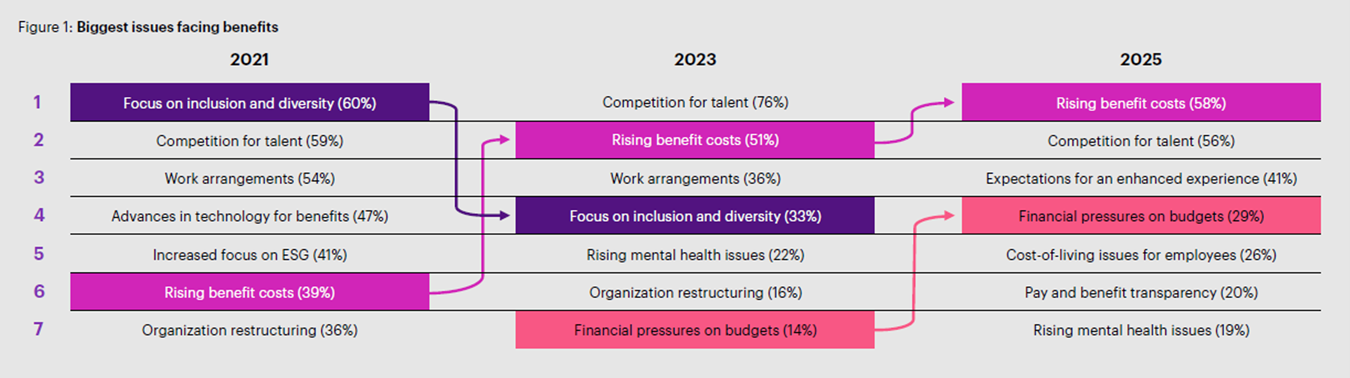
Q: What are the key issues influencing your organisation's strategy for benefits?
Source: 2021, 2023, 2025 Benefits Trend Survey, Global
Financial pressures appear to be a rising concern; rising benefit costs rose from the sixth most key issue in 2021 to the top issue in 2025, and financial pressures on budgets rose from seventh in 2023 to fourth in 2025. We can also see that cost of living for employees has entered the 2025 list at fifth place. There has been a marked decline in DEI as a key issue affecting benefits strategy; it was the top issue in 2021, dropped to fourth in 2023, and is no longer one of the top issues in 2025. Rising mental health issues has dropped from the fifth most key issue in 2023 to seventh in 2025. Working arrangements also dropped off the list in 2025. Competition for talent has been a top-two item across all three years. So, it appears that the most important issues for organisations in 2025 relate to costs and budgets, with wellbeing- and culture-related issues potentially no longer taking priority as strategic objectives. The importance of competition for talent across the years also suggests that candidates want good benefits and organisations need to have strong benefits to compete for recruits, but organisations are increasingly concerned about the cost impacts on their ability to provide these and thus compete for talent.
So what do we suggest to our clients that they do?
- Understand the costs and potential cost rises and work with suppliers to reduce these. On most products there are choices that can be made, from excesses to specific inclusions and exclusions, that can make a real difference. We can talk you through the questions to ask and quotes to ask for.
- Understand what the returns on your benefits may be, e.g. lower sickness absence costs if employees have access to healthcare benefits, both from your own data and typical market data.
- Understand what your employees use and what they value; there is little point in paying for something that is never used. Everyone can get more value for money by targeting spend on what is desirable.
- Review your benefits against the market to understand what is typical. Are you offering benefits at your cost that nobody else does? Are you offering benefits to most or all of your population group that are typically only offered to more senior people? If your offering is above market median, is that a conscious choice you've made or something that has just happened? If you are offering unusual benefits or you're offering them to groups who wouldn't typically receive them, consider the previous point: do people value and use them? Money may be better spent elsewhere. We can help you review your benefits to understand your market position and make recommendations for potential cost savings.
- Understand if there are actions that can be taken or other benefits combined that would lead to lower premiums - for example preventative measures in healthcare.
2. Do more with less (or the same) - rather than expanding their benefits portfolio, 63% of employers plan to reallocate their spending over the next three years. This shift emphasises the need to extract more value from existing benefits and improve their effectiveness.
So what do we suggest to our clients that they do?
- Understand what your employees value and use, perhaps by looking at usage data or by running a survey. As said above, there is little value in paying for something that isn't used and that money might be better spent on different benefits. So you could offer benefits that are more valuable to your employees on a cost-neutral basis.
- Compare products. Look at what your provider offers for a particular benefit and what it costs, and compare that to other providers offerings and their costs, especially if you've been with the same provider for a long time. You may be able to buy a better product for the same or less money. If you're part of a larger organisation, see if providers are willing to offer a volume discount.
- Are there free or low-cost benefits you can offer? We often talk about Total Reward in terms of Maslow's hierarchy of needs, with basic needs like pay on the bottom and more intangible needs like flexibility and personal development at the top. Pay and benefits are unlikely to vary wildly across organisations and people will move for these more intangible aspects. These benefits at the top of the pyramid, like flexibility, personal development, and wellbeing are often low- or no-cost, so consider how your organisation can implement or build on these to stand out from the crowd.
- Look at your communications around benefits: how often are you communicating them, and how? We've seen before that employers may offer rich benefits but employees don't know about them or understand what they have, as benefits are not clearly and consistently communicated. You may be able to increase employee engagement and satisfaction with benefits without buying anything new or otherwise changing your offer, simply by ensuring you regularly remind employees about how the benefits you offer can help them.
3. Employee Experience and Mental Health: Employers are increasingly prioritising mental health and overall employee experience. The survey highlights that 44% of employers are focusing on enhancing health benefits and wellbeing programmes to better support their workforce.
So what do we suggest to our clients that they do?
- Consider a wellbeing allowance. Wellbeing means something different to everyone, and giving everyone the same benefits to support their mental health and wellbeing may not be effective. For example, you could give all employees a subscription to a service like Calm or Headspace, but not everyone finds these helpful. With a wellbeing allowance, they could choose to purchase a subscription or, if it's not useful to them, spend the money on something else that is.
- Menopause and fertility support, through providers such as Peppy, are current benefit trends. These concerns can have major impacts on people's lives and thus on their mental health and experience at work. Whether you offer related benefits through a provider or not, you can support your employees by introducing menopause and fertility policies that make it clear your organisation welcomes and supports people with these concerns.
- Consider mental health holistically. Mental health is not an island; someone's physical health, their financial health, and their experience of community all affect it (among many other things). Preventative health benefits, financial wellbeing and education benefits, and community volunteering are all current benefit trends, so look at what you offer in these spaces, whether you could be doing something more or differently to support these areas, and how you communicate around these areas.
- Ensure your people have access to an EAP and that you frequently remind them of its availability. If you have an intranet and/or a benefits hub/platform, you could customise the layout to pin a banner with the details of the EAP, so that whenever your employees visit these essential pages they are reminded of the support available to them.
4. Strategic Responses: Employers are rethinking their benefits strategies in light of rising costs and shifting workforce expectations. Many are exploring innovative solutions, renegotiating vendor contracts, and implementing new pricing models to manage costs effectively.
So what do we suggest to our clients that they do?
- As we've said previously, review your benefits against the market to understand what is typical, whether you're offering benefits that nobody else offers or offering them to groups that wouldn't typically receive them, and consider what you want your market position to be. Again, we can help you review your benefits against market and make recommendations for achieving your desired market position.
- Look for benefits that most of your staff can access. There is little to be gained from having an amazing benefit if almost all your staff can't afford it. For example, you may offer electric vehicles as part of a suite of flexible benefits and offer a "flex pot". You may be surprised at how large a pot your employees would need to receive before they can afford to choose even the most basic car, or choose the car and still afford any other of the benefits included in the suite.
- Related to the previous point, consider the impacts of salary sacrifice benefits; if you have a large population paid at or close to minimum wage then they won't be able to benefit from salary sacrifice. This can create feelings of unfairness as a benefit is provided but they can't use it.
- If you don't know already, find out what your people would really value. What are their problems, and how can you help them address these? Look at your population demographics; ages, genders, possible stages in life. Consider what will benefit the most people and invest there, not on the peripheries.
5. Personalisation and Value: There is a strong emphasis on delivering personalised benefits that align with employee values and needs. 76% of employers expect to offer moderate to high benefit choice within three years, focusing on simplicity and decision support.
So what do we suggest to our clients that they do?
- Consider offering flexible benefits. Offering your employees the ability to select the benefits that matter to them most rather than giving everyone the same thing, which may be more or less valuable to them, could increase employee satisfaction. Also, if you have a benefits platform, speak to your provider about how they can support you in offering flexible benefits; technology is becoming increasingly sophisticated and may be able to support your employees when making choices about their benefits. For example, it may be able to make recommendations based on previous usage, on income and/or grade (so it won't recommend benefits they couldn't afford to take), age gender, or even lifestyle if you include a "what matters to me section" where people can select if they're interested in health, travel, fitness, etc.
- Consider benefits that can help your employees in lots of different situations and regularly promote these through explaining the various lifestyle impacts. For example, you might offer a workplace ISA (individual savings account), so you could promote it by talking about all the different life events it can help you save towards: buying a house, saving for a wedding, saving up for an extra special holiday, etc., etc.
- As said above, you could consider allowances to give employees choice. This could be a wellbeing allowance as we've discussed above, but you could offer a green/eco-friendly allowance, a social allowance, a holiday-costs allowance, a learning and development allowance, or many other types of allowance. Benefits platform providers may offer this, so speak to your provider if this is something that interests you.
Implications for Employers
The findings from the WTW 2025 Benefits Trends Survey suggest that employers must adapt their benefits strategies to address rising costs while enhancing employee satisfaction. By focusing on optimising existing benefits, improving communication, and prioritising mental health support, organisations can better meet the needs of their workforce and remain competitive in attracting and retaining talent.This very much resonates with what we are seeing and recommending to our clients.
If your organisation is thinking about reviewing benefits, Reward Heads can help. The team bring real-world, practical expertise, not just theory, and we work with you to create a package that can really work for your business and your people. We can help you by reviewing your Reward strategy - including your benefits strategy - and whether it aligns with what you want to achieve, review your benefits against the market, and if desired make recommendations to help you save money while still offering great value to your team through benefits.
You can get in touch with us at rewardsolutions@rewardheads.co.ukWe also run online coaching courses and have two suites of modules covering benefits:
- A four-module suite covering benefits strategy, legal considerations, working with benefits suppliers, and communications and engagements which you can find here: Benefits Coaching bundle of 4 modules
- A six-module benefits and wellbeing suite which includes the four modules above, along with a module on the importance of wellbeing and another about emotional wellbeing in the workplace which you can find here: Benefits Coaching bundle of 6 modules
Steph King - Senior Analyst